 Skip to content


Applying for an Individual Taxpayer Identification Number (ITIN) can feel overwhelming, especially if you’re not a U.S. citizen or permanent resident. The IRS requires Form W-7 for this process. Below, we break down the form section by section so you can complete it confidently.
Quick Answer: What is Form W-7?
Form W-7 (Application for IRS Individual Taxpayer Identification Number) is the official form used to apply for an ITIN. You must complete this form if you:
– Need to file U.S. taxes but aren’t eligible for a Social Security Number
– Are claiming U.S. tax treaty benefits
– Need to be listed as a dependent/spouse on someone’s U.S. tax return
Processing time: 7-13 weeks
Cost: Free (IRS doesn’t charge)
Required: Valid passport + tax return (in most cases)
[Download Form W-7 from IRS →]
[Get CAA Help →]
How to Obtain an ITIN Using Form W-7?
To obtain an ITIN, you need to complete IRS Form W-7 and submit it along with your supporting documents and, in most cases, a U.S. tax return.
Steps:
- Complete Form W-7
- Gather required documents (passport, ID)
- Attach tax return (if required)
- Submit via IRS or Certified Acceptance Agent
- Wait for ITIN approval (7–13 weeks)
What Is Form W-7?
Form W-7 is the official Application for IRS Individual Taxpayer Identification Number.
It is used by individuals who are not eligible for a Social Security Number (SSN) but still need to file U.S. taxes, claim treaty benefits, or be listed as a dependent/spouse on a U.S. tax return.
Step 1: Choose Your Application Type
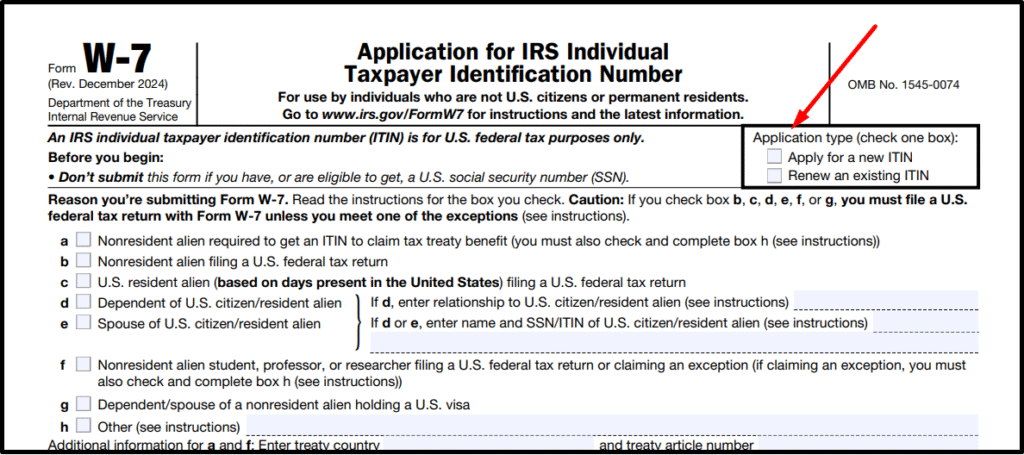
At the very top, check one box:
-
Apply for a new ITIN (first-time applicants)
-
Renew an existing ITIN (for expired or soon-to-expire ITINs).
ITINs expire if:
-
They haven’t been used on a tax return for the past 3 years, or
-
They contain middle digits that the IRS designates as expired (e.g., 70, 71, 72, 80, 81).
Step 2: Select the Reason for Applying
Form W-7 offers several checkboxes (a–h). Each represents why you need an ITIN:

-
a. Nonresident alien claiming tax treaty benefits
-
b. Nonresident alien filing a U.S. tax return
-
c. Resident alien (based on substantial presence) filing a return
-
d. Dependent of a U.S. citizen or resident alien
-
e. Spouse of a U.S. citizen or resident alien
-
f. Nonresident alien student, professor, or researcher
-
g. Dependent or spouse of a nonresident alien visa holder
-
h. Other (with explanation required)
⚠️ Important: For boxes b–g, you usually must attach a U.S. federal tax return unless you meet one of the exceptions (such as claiming treaty benefits or providing ITIN for information reporting only).
Step 3: Enter Your Personal Information

-
Line 1a–1b: Legal name (first, middle, last) and name at birth (if different).
-
Line 2: Mailing address where the IRS should send your ITIN letter.
-
Line 3: Foreign address (if different from mailing address).
⚠️ Important: Many people ask if they can use their LLC address as the mailing address. Yes, but only if you can reliably receive IRS letters there (for example, if mail is forwarded to you). Otherwise, it’s better to use a personal or trusted U.S. address to avoid delays or lost correspondence.
Step 4: Birth Information
-
Line 4: Date of birth (MM/DD/YYYY).
-
Line 5: Gender.
Step 5: Citizenship and Identification

-
Line 6a: Country or countries of citizenship.
-
Line 6b: Foreign tax I.D. number (if any).
-
Line 6c: U.S. visa type, number, and expiration (if applicable).
-
Line 6d: Identification documents submitted — usually a valid passport (most common single document accepted). US driver’s license can be used as an alternative.
-
Line 6e–6f: Indicate if you ever received an ITIN/IRSN before. Provide the number and the name under which it was issued.
-
Line 6g: If you are a student or researcher, provide your school/company and duration of stay.
Step 6: Review and Sign
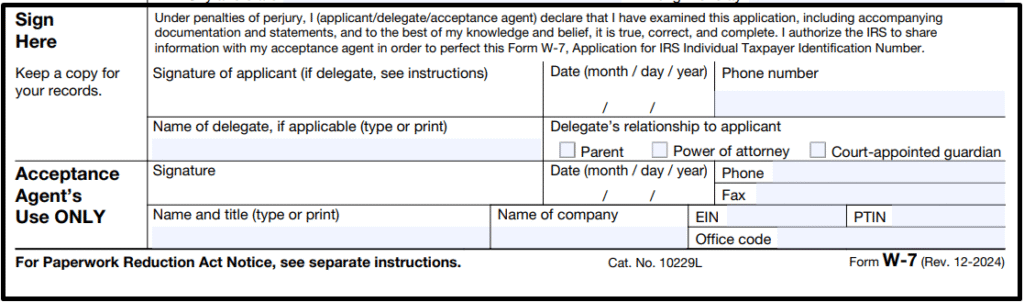
At the bottom:
-
The applicant signs and dates the form.
-
If a delegate or acceptance agent signs on your behalf, their details must be included.
-
If using a Certified Acceptance Agent (CAA), they fill in their section.
Supporting Documents You Need
The IRS requires original documents or certified copies from the issuing agency.
✅ Commonly accepted documents:
-
Passport (most preferred, stand-alone)
-
U.S. Driver’s license or state ID
-
Foreign national I.D. card
-
Birth certificate (required for dependents without a passport)
-
U.S. visa, USCIS documents, or school records (for students/dependents)
📌 Tip: When scanning a passport, place a blank white sheet behind it so the edges and borders are clear. If you’re worried about mailing your original passport, consider working with a Certified Acceptance Agent (CAA) who can verify documents locally.
Form W-7 for Business Owners & LLCs
If you’re a non-U.S. resident who owns a U.S. LLC or earns income from U.S. sources, you’ll likely need an ITIN to:
Why LLC Owners Need Form W-7
1. File Your U.S. Tax Return
Single-member LLCs are treated as “disregarded entities” for tax purposes. This means LLC income is reported on your personal tax return (Form 1040-NR), which requires an ITIN.
2. Open a U.S. Business Bank Account
Many U.S. banks (Mercury, Relay, Wise) require the LLC owner to have either an SSN or ITIN to open business accounts.
3. Comply with IRS Reporting Requirements
If your LLC has U.S.-sourced income, the IRS requires you to file a tax return and pay any applicable taxes. An ITIN is mandatory for this filing.
4. Receive Payments from U.S. Clients
U.S. companies paying you may require Form W-9 (if you have an EIN) or Form W-8BEN (if claiming treaty benefits). Both scenarios may require an ITIN.
What LLC Owners Need to Include with Form W-7
When applying for an ITIN as an LLC owner, submit:
– ✅ Completed Form W-7
– ✅ Valid passport (original or CAA-certified copy)
– ✅ Form 1040-NR (your personal tax return showing LLC income)
– ✅ LLC formation documents (Articles of Organization, EIN Confirmation Letter)
– ✅ Proof of U.S. income (1099 forms, contracts, invoices)
Example: You formed a Wyoming LLC to run an e-commerce business. Your LLC earned $50,000 in 2025. To file your 2025 tax return in 2026, you need an ITIN. You’ll attach Form W-7 to your 1040-NR showing the LLC income.
📚 Related guides:
– [ITIN for LLC Owners (Complete Guide)]
– [Wyoming LLC Formation]
– [Texas LLC Formation]
– [How to Open a U.S. Bank Account as Non-Resident]
Where to Submit Form W-7
-
By Mail
Send Form W-7, supporting documents, and (if required) your tax return to:
IRS ITIN Operations
Internal Revenue Service
P.O. Box 149342
Austin, TX 78714-9342
USA -
In Person (IRS Office)
Apply at a Taxpayer Assistance Center (appointment required). -
Through a Certified Acceptance Agent (CAA)
Recommended option. CAAs can verify your identity documents so you don’t need to mail your passport.
Processing Time
-
Standard: 7–13 weeks (longer during peak filing season or if mailing from abroad).
-
Renewal: Usually quicker, unless combined with a tax return.
-
Using a CAA: Often faster and safer, since your documents don’t need to travel internationally.
Common Form W-7 Mistakes to Avoid
Common Form W-7 Mistakes That Cause Rejections
The IRS rejects thousands of Form W-7 applications every year. Here are the most common errors and how to avoid them:
❌ Mistake 1: Wrong Reason Code Selected
The Error: Checking box “a” (treaty benefits) but attaching a tax return, or checking “b” (filing a return) without attaching one.
The Fix: Match your reason code to your actual tax situation. If filing a return, use box “b”. If only claiming treaty benefits without a return, use “a” + “h”.
❌ Mistake 2: Name Mismatch
The Error: Name on Form W-7 doesn’t exactly match passport (middle name missing, typos, name order wrong).
The Fix: Copy your name EXACTLY as it appears on your passport. Include all middle names.
❌ Mistake 3: Using Photocopies Without CAA
The Error: Submitting regular photocopies of passport instead of certified copies or originals.
The Fix: Either mail your original passport to the IRS, get certified copies from the issuing country, or use a [Certified Acceptance Agent](/itin/) who can verify copies.
❌ Mistake 4: Missing Signature
The Error: Forgetting to sign and date the form at the bottom.
The Fix: Always sign in ink if mailing a physical form. If someone else is signing on your behalf, they must complete the delegate section.
❌ Mistake 5: Expired Passport
The Error: Submitting a passport that expired before the application date.
The Fix: Renew your passport before applying, or provide another valid ID combination.
❌ Mistake 6: No Tax Return Attached (When Required)
The Error: Checking boxes b-g without attaching Form 1040, 1040-NR, or claiming a valid exception.
The Fix: If you’re filing a return, attach it. If claiming an exception (like treaty benefits), clearly indicate this and provide supporting documents (W-8BEN, 8233, etc.).
📚 Learn more: [Common Errors When Filing Form W-7]
Pro Tips
-
Double-check all names and dates match your passport and documents.
-
If renewing, you don’t need to attach a tax return unless you’re filing one at the same time.
-
Keep copies of everything you submit.
-
Use trackable mail if sending documents internationally.
-
If claiming a treaty benefit, attach Form 8233 or W-8BEN as applicable.
- If your ITIN application is rejected, don’t panic. Read our guide on how to fix ITIN rejections and resubmit correctly.
- If you own a U.S. business, you may need both an EIN (for the business) and an ITIN (for yourself as the owner).
Filling out Form W-7 is the first step toward U.S. tax compliance for non-citizens. Whether you’re a student, dependent, spouse, or international investor, completing it correctly helps you avoid delays.
👉 If you’re unsure or want to avoid mailing passports overseas, consider working with a Certified Acceptance Agent (CAA) who can verify your documents, prepare your application, and submit it securely.
Frequently Asked Questions About Form W-7
Q1: Can I fill out Form W-7 online?
No. Form W-7 cannot be submitted electronically to the IRS. You must print, sign, and mail the physical form along with your supporting documents. However, you can download the form from the IRS website, fill it out on your computer, then print and sign it.
Q2: Do I need to attach a tax return to Form W-7?
In most cases, yes. If you checked boxes b-g on Form W-7, you must attach a U.S. federal tax return (Form 1040 or 1040-NR). The only exceptions are:
– Box “a” (claiming treaty benefits) + box “h” (exception)
– Spouses/dependents claiming an exception
– Third-party withholding situations
Q3: How long does Form W-7 processing take?
Standard processing is 7-13 weeks from the date the IRS receives your complete application. During peak tax season (January-April), it may take up to 16 weeks.
Q4: Can someone else sign Form W-7 for me?
Yes, if you authorize a delegate (family member, attorney, or Certified Acceptance Agent to act on your behalf. The delegate must complete the signature section and provide their information.
Q5: What happens if my Form W-7 is rejected?
The IRS will send you a rejection letter explaining the reason. Common causes include:
– Incomplete form
– Missing or invalid documents
– No tax return attached (when required)
– Expired passport
You can correct the errors and resubmit. If you used a CAA and the rejection was due to our error, we resubmit for free. Learn more: ITIN Rejection Fix
Q6: Can I use Form W-7 to renew my ITIN?
Yes. Check the “Renew an existing ITIN” box at the top of the form. You don’t need to attach a tax return unless you’re filing one at the same time.
Q7: What if I made a mistake on Form W-7 after mailing it?
Contact the IRS ITIN hotline at 1-800-829-1040 (international: 1-267-941-1000). If the error is minor, they may be able to process it. For major errors, you may need to resubmit.
Q8: Do I need to pay to file Form W-7?
No. The IRS does not charge to process Form W-7. However, if you use a professional service or Certified Acceptance Agent, there may be service fees ($299-$699 depending on whether tax return preparation is included).


